Article: What is neuroathletics? Learn all about the new trendy sport
What is neuroathletics? Learn all about the new trendy sport
Reading time: 8 minutes
It sounds like science fiction, but it's a training reality: training your brain with targeted exercises to improve your mobility, reduce pain, shorten your reaction time – and even make your eyes fitter. But that's exactly what Neuroathletics promises. What started as an insider tip in elite sports is now also being used in everyday life, in therapy and in health training. Find out here why more and more people are relying on the smart combination of brain training and movement and how you can also benefit from it.
Table of Contents
- What is Neuroathletics?
- Neuroathletics as a new training method
- How does Neuroathletics work?
- What are the benefits of Neuroathletics?
- Neuroathletic training against everyday complaints
- Who is Neuroathletics suitable for?
- Holistic training for many sports
- 3 Neuroathletic exercises to get started
- How can I become a Neuroathletics trainer?
- Conclusion: Neuroathletics – a holistic training approach with a future
What is Neuroathletics?
Neuroathletics is a training approach that specifically targets the nervous system to optimize movement sequences and increase performance. The focus is on the head and body as a unit. Because: Our brain regulates and controls everything in the body. It takes external and internal information as input via sensory organs such as our eyes, processes and interprets them with our existing knowledge and generates a final result, the output. In sport, the decisive output is movement. How we move is determined by the processes in the brain and nervous system - this is where Neuroathletics comes in.
Neuroathletics as a new training method
While neuroathletic training in Germany was primarily made known by sports scientist Lars Lienhard, this approach to brain training and movement control originally comes from the USA. Here, in the early 2000s, athletic trainer Eric Cobb began to combine the two disciplines of athletic training and neuroscience. This was the birth of Neuro Athletic Training.
Cobb combined insights from neuroscience with practical experience from therapy and training to create his own training concept with corresponding training methods, the Z-Health Performance Education System.
How does Neuroathletics work?
For every movement we perform, the brain requires sensory information from the three movement-controlling systems
- eyes (visual system),
- balance (vestibular system) and
- body awareness (proprioceptive system).
The clearer and higher quality the signals from these systems, the better the physical performance. If there are communication disturbances or the information is too weak, this negatively affects training success.
Exercises that focus on these processes and weaknesses of the nervous system are called neurotraining. It helps to optimize these processes to improve performance and prevent injuries. Since this topic also plays a major role in elite sports, the terms neuroathletics, neuroathletic training or NAT are often used.
For a better understanding, a small digression into our three movement-controlling systems:
The visual system: our eyes
Almost all our movements are controlled by our eyes. The input provides our brain with all important information about our environment, which makes a targeted movement possible in the first place. Even small losses of information or disturbances can lead to a suboptimal movement result. Overworked eyes can also lead to headaches, concentration problems and neck tension. They are also closely connected to the sense of balance. Therefore, it is worthwhile not only to let your eyes rest, but also to strengthen them specifically. This is where visual training comes in.
Visual training basically works like a workout for your eyes. You train the eye muscles, the cooperation of both eyes and the coordination with the brain. With regular training, you can make great progress. It is important to remember: Take breaks! Especially at the beginning, training for the eyes is quite demanding. Therefore, 10 minutes a day is completely sufficient. Depending on the variation, you can easily adapt the training to your own pace and needs.
The vestibular system: our balance
Our organs of balance are located in the inner ear. They measure the acceleration of head and body movements, thus enabling us to orient ourselves in space. They send this information to the brain and form the basis for our posture (muscular tension) and eye alignment. A functioning balance system is the absolute foundation for precise movement execution.
Our balance system supports the visual system by stabilizing the eyes. The visual system, in turn, supports our balance by providing images and external reference points. You've probably experienced this yourself: with your eyes closed, it becomes difficult to walk straight. After just a few meters, you usually stray off course. The reason: without visual support, the necessary orientation is simply missing.
>> Reading tip: 3 Neuroathletic exercises for dizziness
The proprioceptive system: the body's GPS
Proprioception is something like your body's internal GPS. It ensures that you always know where your arms and legs are – without looking. For example, when you feel for the light switch in the dark or grab your glass without looking.
For this to work smoothly, joints and surrounding structures must be highly mobile. Only then can your body send precise signals and enable clean, coordinated movement. The better this system works, the smoother everything else runs, from posture to athletic performance.
What are the benefits of Neuroathletics?
All body parts have a kind of representation in the brain. The representations for the face, hands and feet occupy a particularly large area. This is because there are particularly many sensory organs – the receptors – located here, and we use these areas intensively and in a variety of ways from birth. Faulty or missing reports from these areas therefore have enormous effects on movement and quality of life. In addition, important sensory organs such as our feet are used less and less as we get older.
The information superhighways that were initially laid out degenerate into trampled paths, over which only a few unclear pieces of information can be transported. The result: We can no longer perform certain movements, become immobile and anxious, because our brain registers such movements as a danger and thus ensures that we avoid such stimuli. It first has to learn again that there is no dangerous situation involved in such movement sequences.
In everyday life and especially in sports, we not only move our body. We constantly have to perceive our own position in space as well as that of obstacles or opponents, compare them with each other and, ideally, react flexibly to unpredictable events such as uneven ground, opposing contacts or slipperiness. The smoother and more correctly these processes run and the less danger our brain perceives, the better the result.
In short: Neuroathletics helps you to perform movements more safely, fluidly and consciously. In everyday life as well as in sports.
Neuroathletic training against everyday complaints
Neurotraining offers enormous potential for everyone. From toddlers to seniors, from seemingly healthy people to chronically ill people. It can have positive effects on
- Stress,
- Digital Overload,
- Pain,
- Fatigue and lack of energy,
- Joint blockages and restricted mobility,
- Visual problems such as tired eyes and impaired vision,
- Performance deficits or plateaus in sports as well as dizziness,
- Reading and spelling disorders,
- ADHD and
- Anxiety.
Who is Neuroathletics suitable for?
In short: For everyone! Neuroathletic training can have positive effects for everyone – regardless of age or fitness level.
Neurotraining can be interesting not only for adult, sporty people or even athletes. This form of training, which can be applied in very different degrees of difficulty and also for untrained people, offers a lot of potential – for everyone. From toddlers to seniors, from seemingly healthy people to chronically ill people.
In everyday life, for example, you can treat many different types of pain or simply train your eyes – for relaxation or to improve your eyesight. Your options are varied and there is something for every part of the body.
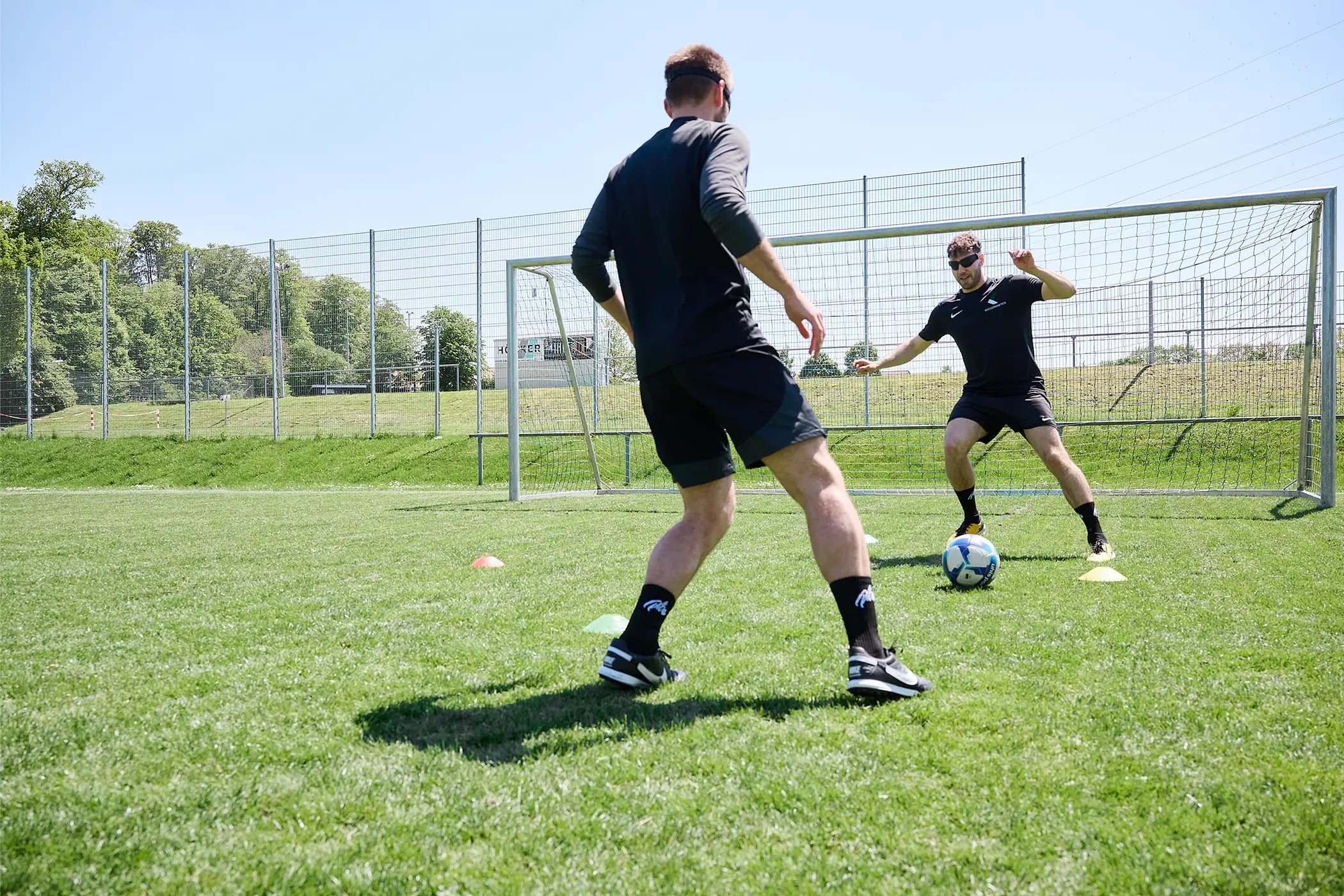
In competitive sports, neuroathletic exercises can help to improve reaction time and thus increase your performance. Sensorics and perception, i.e. the improvement of input in the brain, are increasingly coming into focus in professional football training, for example.
>> Reading tip: How to implement neurotraining in football: Train like Gnabry and Musiala
The exercises are often the same, and the approach and goal also remain the same: the improvement of the interaction between brain and body. How you want to use this is up to you.
Holistic training for many sports
Most training approaches and forms of training are highly output-oriented: they focus on the final movement, faulty movement patterns or the pain point. The information input and its processing, on the other hand, are often neglected. In training, too, we should pay attention to how information is received and processed in order to achieve the best possible result.
If, for example, our eyes can only see limited, can only follow a ball in a jerky and blurred way, if we lose our balance with every small bump or only receive limited information about the ground via our feet, this has immediate effects on our movement – and thus on our performance.
Neurotraining can help to restore the original, innate abilities for stimulus processing and thus improve our quality of life and performance in almost all areas of everyday (sporting) life. This is why neuroathletics is becoming increasingly important in football and tennis, for example – because here it is particularly important to estimate distances precisely and to optimally coordinate the interplay between eye and foot or eye and arms.
3 Neuroathletic exercises to get started
Among the simplest neuroathletic exercises are those that train your eyes. You don't need much for them, and you can perform them quickly and anywhere. Especially with today's excessive screen time in everyday life, a few minutes of eye training a day can be very relaxing.
Here are 3 eye exercises that you can easily integrate into your daily routine:
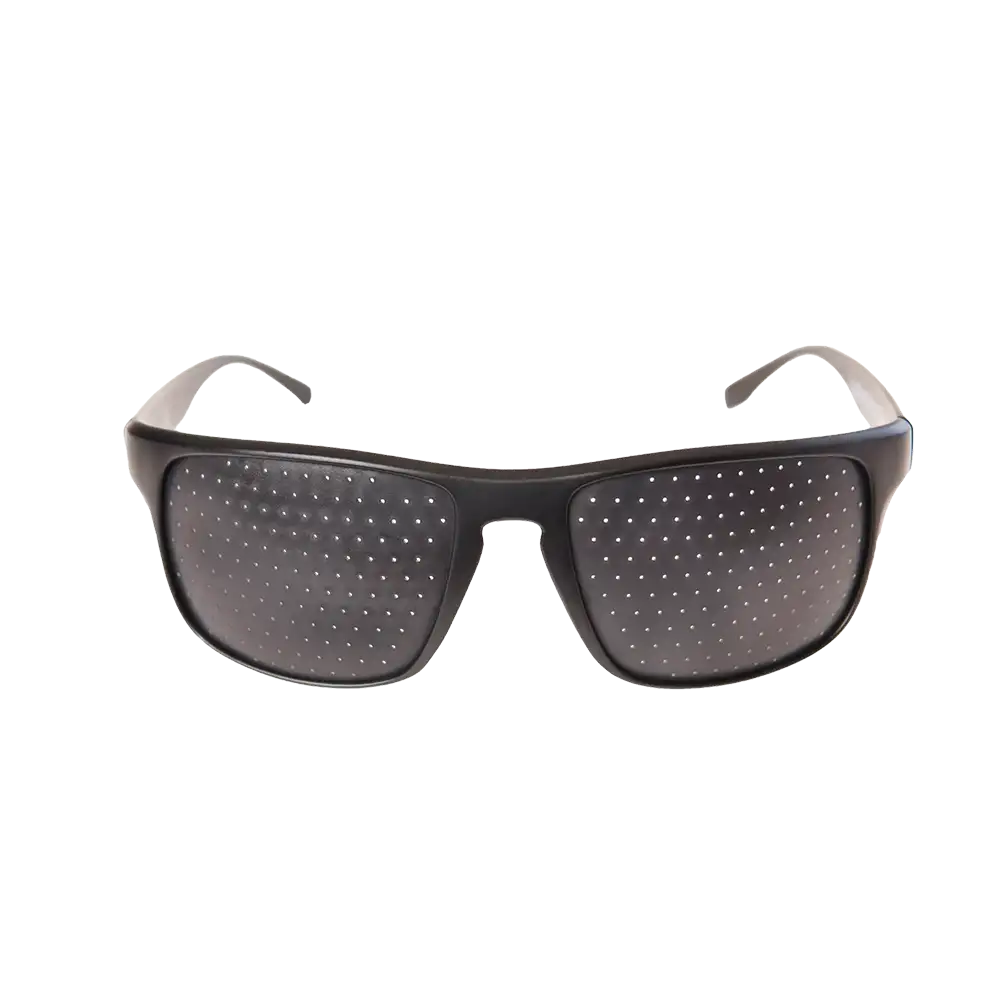
Exercise 1: Relax your eyes with pinhole glasses

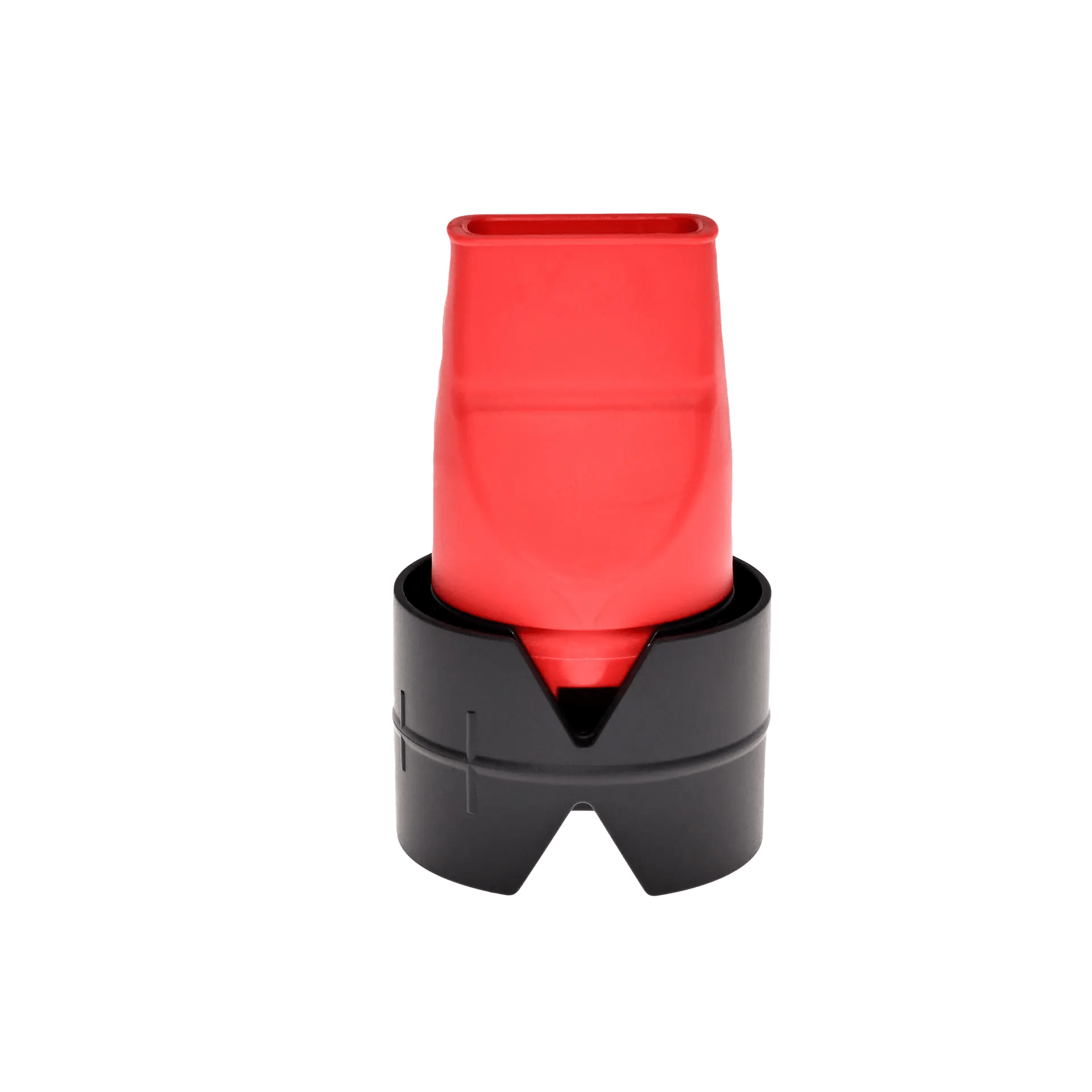
How it works: Wear the pinhole glasses in everyday life. At the computer, while reading, cleaning or playing sports - in areas where you feel comfortable with them. Wearing them may feel unusual at first, but that quickly passes. Initially, wear the pinhole glasses for approx. 5 - 10 minutes. If necessary, you can gradually intensify the training.
Tip for spectacle wearers: Wear the pinhole glasses instead of your regular glasses. You will notice that after a short period of getting used to them, they can partially or even completely compensate for your visual impairment.
What are the benefits? Pinhole glasses relax your eyes by reducing the stress factor of light, while focusing the incoming light pointwise. In cases of visual stress, for example due to old head injuries (such as a concussion or whiplash) or long hours of computer work, the glasses can help to relieve the brain and improve your performance.
They also give you a clearer view. Therefore, they are often used in combination with other vision exercises.
Exercise 2: Seeing clearly

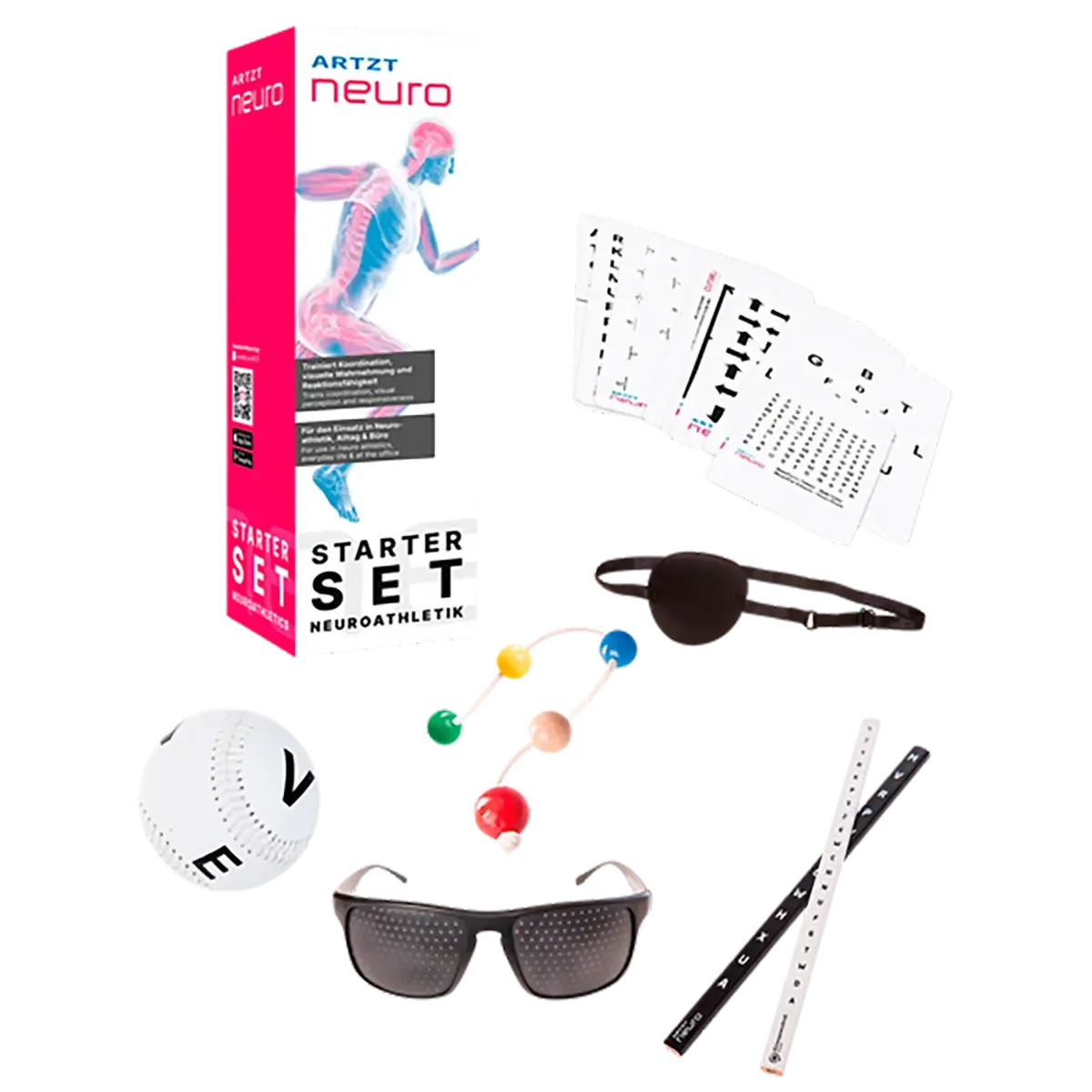
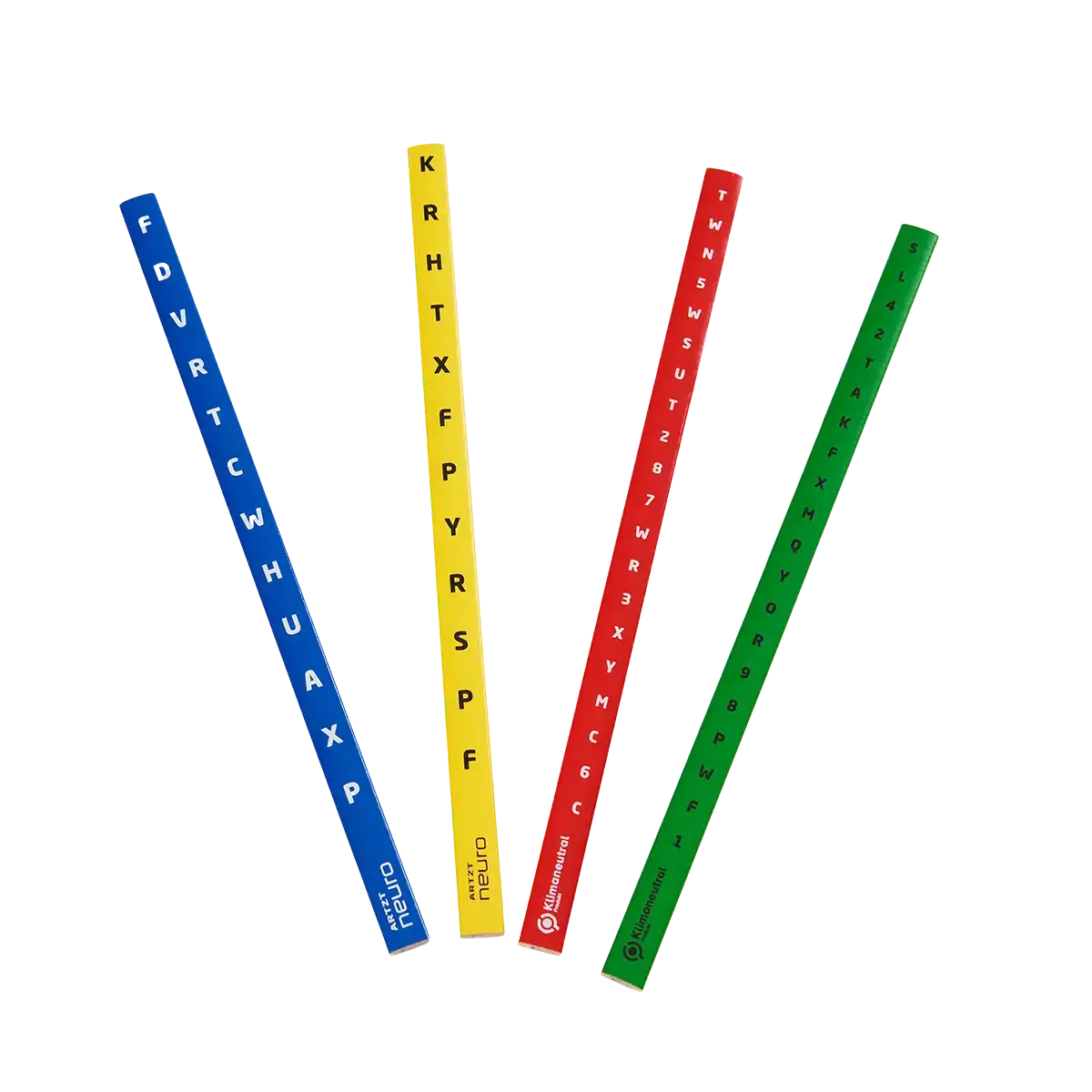
How it works: Hang the distance chart on the wall and stand far enough away that you can just barely see the letters clearly. Hold the near chart in your hand, also at a distance where you can just barely recognize the letters clearly.
Now alternately read a letter close and far. Only switch charts when you have recognized the letter completely clearly.
What are the benefits? By switching between the two charts, your eyes have to refocus again and again. This trains your ability to quickly switch between near and far vision. This is particularly important in everyday life – for example, when switching your gaze between your smartphone and your surroundings in traffic, or between the ball and teammates in sports.
Exercise 3: Object tracking

How it works: Lie on your back on the floor in a relaxed position. Hang the Marsden Ball approximately 60–100 cm directly above your face. Let the ball swing in all directions, following it with your eyes (fixating on the letter at the bottom of the ball).
What are the benefits? This exercise can help you better focus on moving objects. This is an essential skill, especially for ball sports players. But also in everyday life – for example, when driving, during conversations, or when working on a screen – flexible focusing helps you react faster.
>> All Neuroathletic exercises can be found here
>> Neuroathletic Exercises as PDF download
[[featured_products]]
How can I become a Neuroathletics trainer?
Neuroathletic training is gaining increasing attention. More and more trainers and therapists are integrating this approach into their repertoire. Accordingly, the range of training and further education courses in Germany is also continuously growing.
>> All further education dates at a glance
Conclusion: Neuroathletics – a holistic training approach with a future
The innovative approach of brain training is currently experiencing a strong upswing – similar to fascia training in the past. More and more athletes, therapists, and health-conscious individuals are relying on this effective form of training to improve movement quality and body awareness.
Neuroathletic exercises can help you reduce pain, engage your muscles more precisely, and optimize the interplay between body and brain – in everyday life and in competitive sports. If you are open to new approaches, neuroathletics can create real added value for your health, performance, and well-being.
This article was originally published on 02.06.2025 on artztneuro.com

Written by Jonas Schön