Interview with former DFB physiotherapist Klaus Eder: ‘After the game is before the game’
This article, featuring an interview with former DFB chief physiotherapist Klaus Eder, highlights how crucial professional, closely integrated physiotherapy is for performance, regeneration and injury prevention in elite sports.
- Role of the medical department at tournaments such as the World Cup, including the treatment process and coordination within the team.
- Requirements for qualifications, diagnostic competence and experience of sports physiotherapists.
- The importance of correct diagnosis in muscle injuries and the use of functional training in rehabilitation.
Reading time: 3 minutes
"After the game is before the game." This quote from former national football team coach Sepp Herberger applies particularly to the national team's medical department. Injuries must be treated and preventative measures taken to ensure that as many players as possible are fit for the next match.
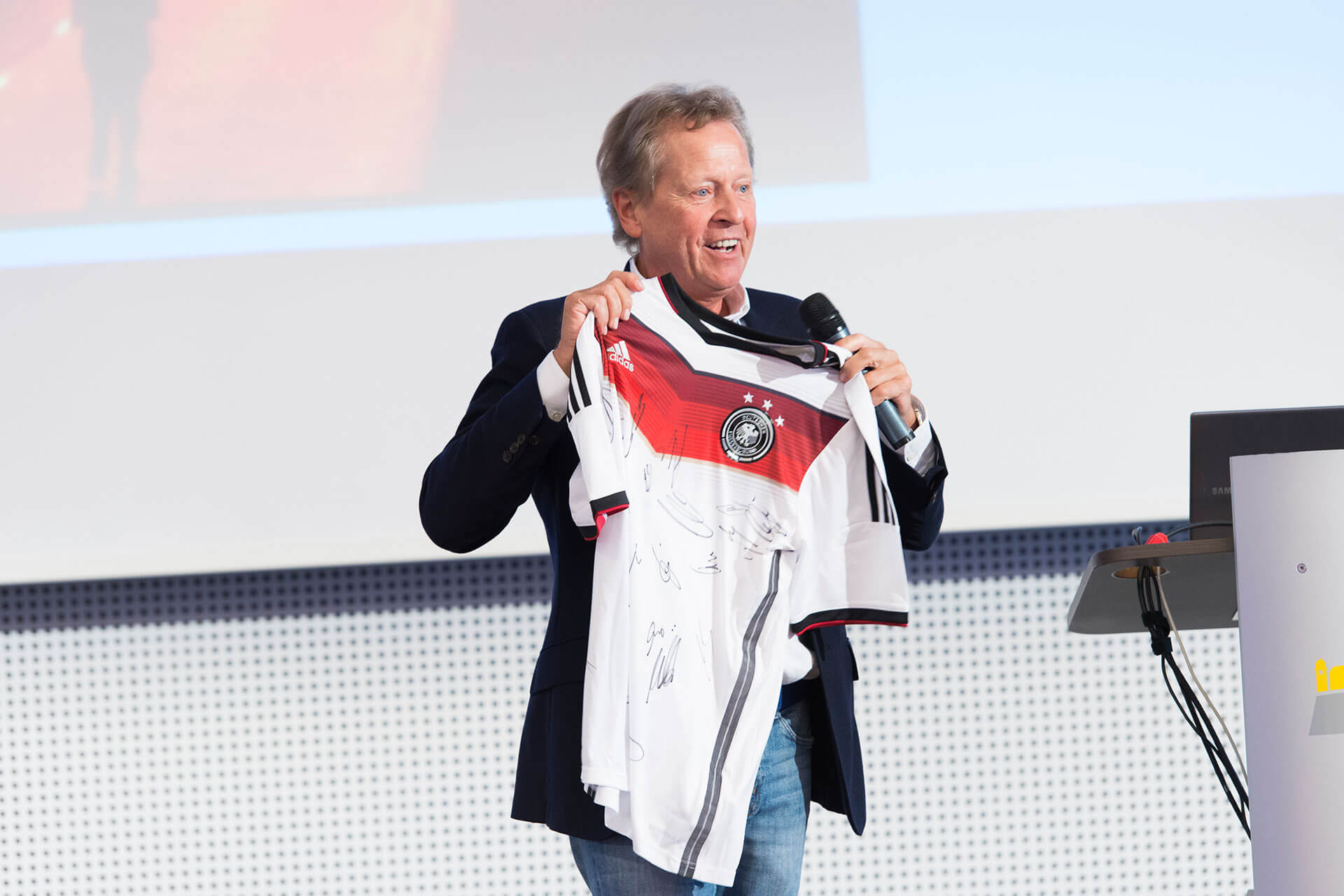
Klaus Eder, as chief physiotherapist of the DFB , was part of the team behind the team and has accompanied the national football team to games and tournaments since 1988.
ARTZT: Klaus, important players like Bastian Schweinsteiger or Sami Khedira were fit again after injury breaks when it mattered most. How important is the role of the medical and therapeutic department around a tournament like the 2014 World Cup in Brazil?
Klaus Eder: We are excellently positioned in the medical field and also need a functioning, well-coordinated treatment team to restore injured players as quickly as possible. Based on an exact medical diagnosis, a physiotherapy treatment plan then needs to be created.
If the player receives the best possible treatment, they can often be brought back to a good condition in time for the next match, provided the injury allows it. Especially during a World Cup, our physiotherapy department is on duty around the clock.
A: What does your workday look like during a major event?
KE: Between matches, we look after the players from eight in the morning until eleven at night, then meet with the medical department to discuss which player needs a specific type of treatment. We also celebrate wins and losses in our treatment room, depending on whether the treatment is working or not improving the player's condition as desired.
During a match, we are naturally also called upon to help. For example, if a player's ligament comes loose from its anchoring point on the bone, we cool the area and reposition the ligament to reduce the pain and allow the player to continue. An exact diagnosis can only be made after the match and may require further treatment.
A: How has physiotherapy in elite sports changed in recent years?
The demands are constantly increasing, and new challenges must always be overcome. Everything has become much more professional, not only the coaching staff, which has expanded considerably and taken on new responsibilities, but also the players.
The foot alone has 26 joints. If one is not in its correct position, the functionality of the active and passive musculoskeletal system can be impaired.
KE: What knowledge do physiotherapists in elite sports need to possess?
All physiotherapists wishing to work for a national A-team require a license from the German Olympic Sports Confederation (DOSB) as a sports physiotherapist. Comprehensive knowledge of manual therapy and osteopathy is also essential. A solid understanding of anatomy and biomechanics, along with appropriate training, is indispensable. Without a physiotherapeutic diagnosis to determine the cause of the symptoms, the physiotherapist would ultimately be treating the patient blindly.
Of course, a physiotherapist's years of experience also play an important role. Furthermore, one must be prepared for the fact that players occasionally unload their personal problems or frustrations in the treatment room.
A: Can you give us an example of how important a correct assessment is in physiotherapy?
KE: If we consider muscle injuries, for example, we distinguish between structural damage with bleeding (muscle fiber tear, muscle bundle tear or muscle rupture) and structural damage without bleeding, such as mechanical overload or improper loading, strains or trigger bands (twisted fascial bands).
Depending on the findings of the doctor or physiotherapist, a differentiated treatment plan can be developed to restore the function and performance of the musculoskeletal system. Of course, the treatment strategy can be misguided if the diagnosis is incorrect.
Therefore, cooperation and consistent terminology within the medical department are of utmost importance in order to ensure appropriate treatment and rehabilitation of the patient.
A: What role does functional training play in the rehabilitation of athletes?
KE: Functional training doesn't just target individual muscles, but trains entire muscle chains. Therefore, rehabilitation involves working not only the affected area, but also the surrounding muscles. A variety of small equipment allows for exercises to improve strength, coordination, and stabilization. These exercises can be specifically designed to prepare for future movement patterns.
Originally published in A-Paper 01/2018 .

Written by Jonas Schön