
Pain-free thanks to fascia therapy: symptoms, treatment methods and effective fascia tools
This article explains how fascia, as a connective tissue network, influences pain and movement, and how you can treat it with targeted fascia therapy and appropriate tools.
- Describes typical symptoms and causes of fascial problems such as pain, stiffness, and restricted movement.
- Presents key therapy methods, such as IASTM, osteopathy, Rolfing and Fascial Distortion Model.
- Explains professional fascia tools such as Fazer and Fazer Hooks for practical use, as well as a fascia tool for home training.
Reading time: 6 minutes
Stress, lack of exercise, back pain – even protective fascia can be damaged, affecting the entire body. Fascia contains many nerve endings that can be responsible for everyday ailments . Therapeutic methods such as device-assisted fascial therapy can treat and prevent fascial injuries. In this article, you'll learn all about typical symptoms and complaints, recognized treatment methods , and effective fascial tools.
Contents
What are fascia?
Fasciae are connective tissue-like structures that act as buffers between tissue layers . Primarily composed of collagen fibers and water, they form a net-like tissue that provides stability to the body. Fasciae envelop and connect organs, muscles, and other structures, ensuring smooth movement and flexibility. Adhesions or mats in the fasciae can reduce flexibility and lead to pain and restricted movement .
Symptoms and causes of fascia problems
Symptoms of fascial problems include pain, restricted movement, and loss of strength . Other signs can be stiffness, muscle tension, and a feeling of pressure or tightness. They are diagnosed through manual tests and imaging procedures that visualize adhesions and thickenings in the tissue. Fascial problems arise from, among other things:
Incorrect or excessive strain
Incorrect or excessive strain leads to biochemical changes that cause fascia to thicken and calcify. Excessive or improper stress can cause micro-tears and inflammation, reducing the elasticity and flexibility of the fascia. In the long term, this results in chronic pain and restricted movement.
Lack of exercise
Fasciae need constant movement to stay well-hydrated and supple. A lack of movement can cause the fascial tissue to atrophy and become matted. Without regular movement and stress, fasciae lose their gliding ability and flexibility, leading to tissue hardening and compression. This can result in painful adhesions and restricted mobility.
Stress and inflammation
Chronic stress increases the production of stress hormones like cortisol, which can lead to muscle tension and fascial hardening . Inflammation caused by injuries or illnesses can also negatively affect the structure and function of the fascia. This leads to an increased susceptibility to adhesions .
What is fascia therapy?
Fasciae are extremely malleable and therefore adapt to all kinds of stresses over the long term. Fortunately, they are also able to return to their original physiological state – provided they receive support. All connective tissue structures are capable of contracting and relaxing under the influence of even slightly increased pressure. Accordingly, manual (osteopathic) treatments can influence cellular metabolism and stimulate a gradual structural reorganization of the fascial components. Various methods, approaches, and tools exist for treating fascial disorders.
Therapy methods for fascia
Fascial therapy aims to restore the natural mobility of the fascia and prevent physical ailments. A variety of fascial exercises and methods are available:
Instrument-Assisted Fascial Therapy (IASTM)
It is not uncommon for various pain sources to be caused by adhesions or matting of the fascia. Instrument-assisted fascial therapy (IASTM = Assisted Soft Tissue Mobilization) aims to combat such hardening. IASTM uses special tools and fascial devices to release adhesions and hardening. The advantage: This device-assisted method protects the therapist's joints and allows for precise work.
Osteopathy: The body as a functional unit
According to Andrew Taylor Still, the founder of osteopathy, the body's systems influence one another. Disorders in one area can affect other areas through interactions. Therefore, the body should always be viewed as a functional unit . Gentle mobilization and stretching of the fascial tissue are intended to release blockages and activate the body's self-healing powers.
Rolfing: For more balance in the fascial system
As early as the 1950s, biochemist Ida Rolf recognized the crucial role of human connective tissue in tension and back pain. From this, she developed Rolfing, a massage technique specifically targeting the fascial connective tissue . Rolfing aims to reorganize and balance this connective tissue in the body. Through myofascial massage techniques, combined with physical exercises, misalignments are corrected, and tension, adhesions, and energy blockages are released .
Fascial Distortion Model (FDM)
The Fascial Distortion Model (from Latin *distorsio*: twisting/dislocation) was developed by emergency physician and osteopath Stephen Typaldos, drawing on osteopathic principles. It is based on diagnosis through medical history, symptom presentation, and the patient's body language. Unlike osteopathy, this concept focuses on local treatment using forceful techniques . By applying strong pulling or pushing, the pathological cross-links are intended to be released more quickly, and the separated fascia is to be untwisted or rejoined, thus achieving faster treatment success.
What instruments are available for IASTM?
Professional fascia tools for physiotherapists
The following tools are exclusively professional instruments that should only be used by appropriately trained individuals. They are made of metal. The advantage: materials like stainless steel and aluminum are extremely durable, do not deform, and show minimal wear, unlike comparable devices made of wood or plastic. A well-maintained fascia tool can last a therapist a lifetime.
Fascia treatment with Fazer
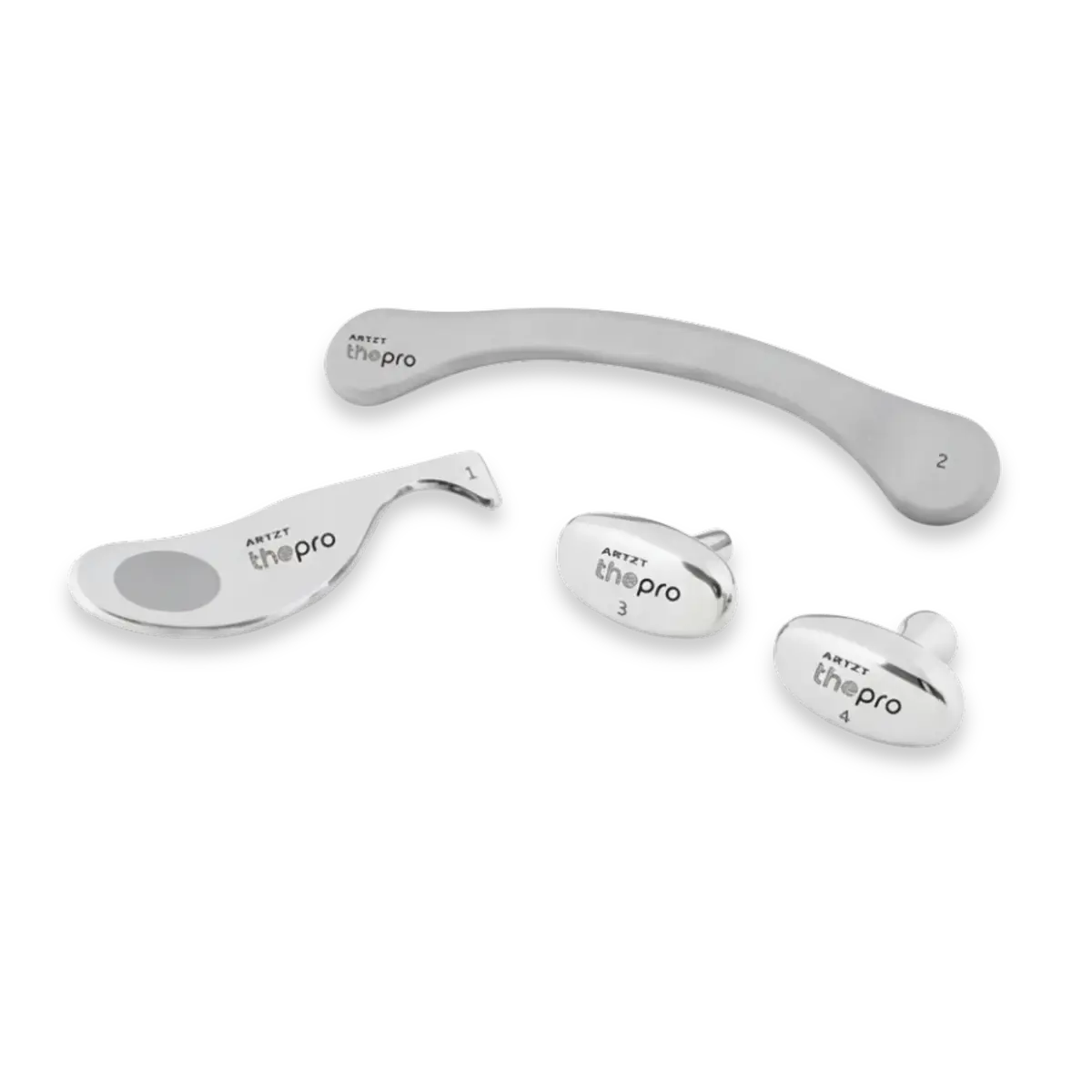
Fazer consists of five therapeutic treatment instruments made in Switzerland from high-quality, corrosion-resistant stainless steel that meets the highest standards. The materials used are also employed in surgery. Each of these tools has been designed and forged for specific treatment techniques or body regions.
There are five Fazer instruments in total. They differ in shape and application, but all are made of surgical steel, which is completely skin-friendly and very easy to clean. This material also has a very high density, allowing tension and knots in the tissue to be felt and located directly through the instruments.
Fazer instruments can be purchased individually or as a set containing instruments 1-4. This set also includes a cleaning cloth and two massage gels. Everything is packaged in a practical instrument roll, making the complete Fazer set easy to transport and always readily available.
Conclusion: Treat fascia professionally throughout the entire body
Fasciae are adaptable and can regenerate through targeted treatments. Manual techniques and instrument-assisted therapies can effectively address fascial issues. A holistic approach is key to healthy fasciae and a flexible body. Get the best fascia tools and take the next step in your therapy!
Sources
- Liptan, G.: Fascia: A Missing Link in Our Understanding of the Pathophysiology of Chronic Pain, in: Current Pain and Headache Reports, 2014
- Cleveland Clinic: Fascia, 2022
https://my.clevelandclinic.org/health/body/23251-fascia - Verywell Health: What is Fascia?
https://www.verywellhealth.com/what-is-fascia-5079645 - European Rolfing Association: What is Rolfing?
https://rolfing.org/de/was-ist-rolfing/rolfing-erklaert - Müller, A.: Fascia training, in: Hessian Medical Journal, 2024, https://www.laekh.de/fileadmin/user_upload/Heftarchiv/Einzelartikel/2024/04_2024/Faszientraining.pdf
This article originally appeared on arztneuro.com on August 15, 2024.