Neuroathletics for Therapists – Physio Meets Neuro
Reading time: 15 minutes
What happens when two experts from different fields meet – and discover that their methods not only complement but also reinforce each other? This is exactly what Berengar Buschmann and Yassin Jebrini have done. Their goal: to integrate neuro-athletic training into physiotherapeutic practice.
In this article, we provide you with an understandable, compact introduction to the theory and, above all: concrete practical exercises that you can immediately integrate into your daily therapy routine. Plus some helpful tips from practice to make getting started easier.
Contents
- What is Physio meets Neuro?
- More than Movement: What Really Happens in the Nervous System
- Considering the Whole Body
- Neurocentric Application in Practice
- Hands-on Neuro-Athletics: 4 Applications for Your Practice
-
Interview with Berengar Buschmann and Yassin Jebrini
- Conclusion: Neuro-Athletics in Physio Practice: An Approach that Thinks Ahead
- Our Authors and Experts
What is Physio meets Neuro?
Physio meets Neuro is a project that connects two worlds: physiotherapy and neuro-athletic training. Together, experts Berengar Buschmann and Yassin Jebrini explore the strengths and overlaps of both methods and try to harmonize them. The intention of the campaign is to introduce therapists to the principles of neuro-athletic training and encourage them to integrate these into their daily work. The aim is to deepen the understanding of the interplay of nervous, muscular, and connective tissue systems and to develop new, holistic treatment approaches. Neurocentric methods can also be specifically combined with proven concepts such as Bobath or PNF, which are particularly used in neurological deficits.
Neuro-athletic trainer Yassin and physiotherapist Berengar have developed methods to meaningfully combine targeted techniques from neurocentric training and physiotherapy. A treatment concept that focuses specifically on coordination, movement control, and neuronal integration – with the goal of long-term improvement of functional movement patterns. This can already and will in the future help many people mentally and physically.
More than Movement: What Really Happens in the Nervous System
Movement appears simple at first glance: sensory organs receive a stimulus, the brain processes it, and sends a signal to the muscles. But behind this simple formulation lie complex neurological processes and certain protective patterns that can be thrown out of balance by injuries or neuronal damage. Neurocentric training stimuli directly target the CNS and influence neuronal processing. They can be used during rehabilitation to influence these complex neurological processes and reduce disproportionately high protective patterns.
Considering the Whole Body
The vestibular system (cranial nerve VIII – N. vestibulocochlearis) is central to our orientation in space and the body's posture against gravity. It is closely connected to the visual and proprioceptive systems. From a neurocentric perspective, this interaction can be specifically used therapeutically – for example, to reduce pain in the hip flexors during a deep squat.
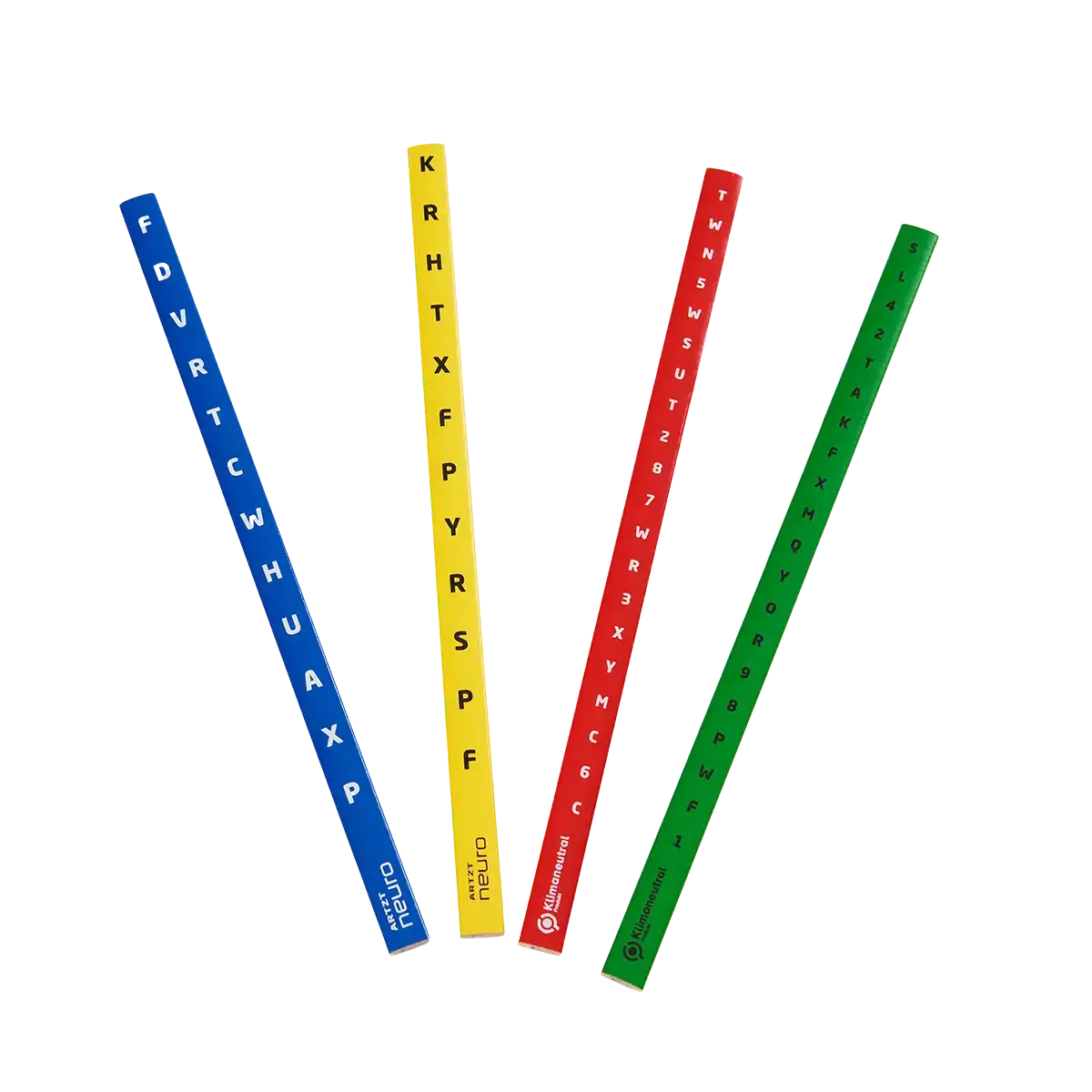
A simple application: The patient slowly squats to the pain point while fixing their gaze on a low-held target (e.g., the Vision Stick). Then, they quickly return to a parallel stance. Through this combined stimulus, sensory input in brain areas such as the mesencephalon, pons, cerebellum, and thalamus is processed in such a way that the brain can better predict movements. This reduces protective mechanisms such as pain and extends the range of motion – often after just a few repetitions.
Movement Starts in the Head – And Goes Through the Brainstem
From movement planning to execution, several structures are involved: the limbic system, the association cortex, the thalamus (part of the diencephalon), the cerebellum, and the brainstem with the medulla oblongata, pons, and midbrain work closely together. These networks modulate every movement – even with seemingly local complaints like hip problems.
However, sometimes classic training alone is not enough to improve flexion. This is where a different approach comes into play: the targeted activation of cranial nerves III (N. oculomotorius), IV (N. trochlearis), and VI (N. abducens), which are responsible for eye movements.
Why is this useful? Binocular vision is the central function of the visual system and is closely linked to postural reflexes. While these reflexes do not directly affect the hip, through neuronal connections, a targeted eye position, e.g., downwards and inwards, can promote the activation of the brainstem and thereby improve flexion ability (see Fig. 2 a – d).

Fig. 2 a – d: Control of binocular function: smooth pursuit eye movement with the Vision Stick near the tip of the nose downwards and forwards to activate the midbrain and pons
[[featured_products]]
Fine-tuning by Cerebellum and Thalamus
The brain controls every movement – but it also limits them when protective patterns like pain are active. Therefore, not only muscular output is important, but also the processing of sensory input. Especially the cerebellum and the thalamus take on central tasks here.
The cerebellum is functionally divided into three areas:
- Vestibulocerebellum & Spinocerebellum: control posture, trunk movement, and muscle tone
- Pontocerebellum: coordinates targeted movements and speech motor skills
- Vestibulocerebellum: stabilizes gaze motor skills on one spot
In the thalamus, it is then decided whether a movement will be executed as planned. The result is relayed via the motor cortex (precentral gyrus) to the spinal cord – via pyramidal and extrapyramidal tracts, including the cranial nerve nuclei in the reticular formation of the brainstem. Only then is the movement impulse finally transmitted to the periphery – and becomes visible.
Neurocentric Application in Practice
Example: Control of Binocular Function
By targeted smooth pursuit eye movement with the Vision Stick – close to the tip of the nose downwards and forwards – the midbrain and pons can be activated (Fig. 2 d).
Example: Pain Reduction in Hip Flexion
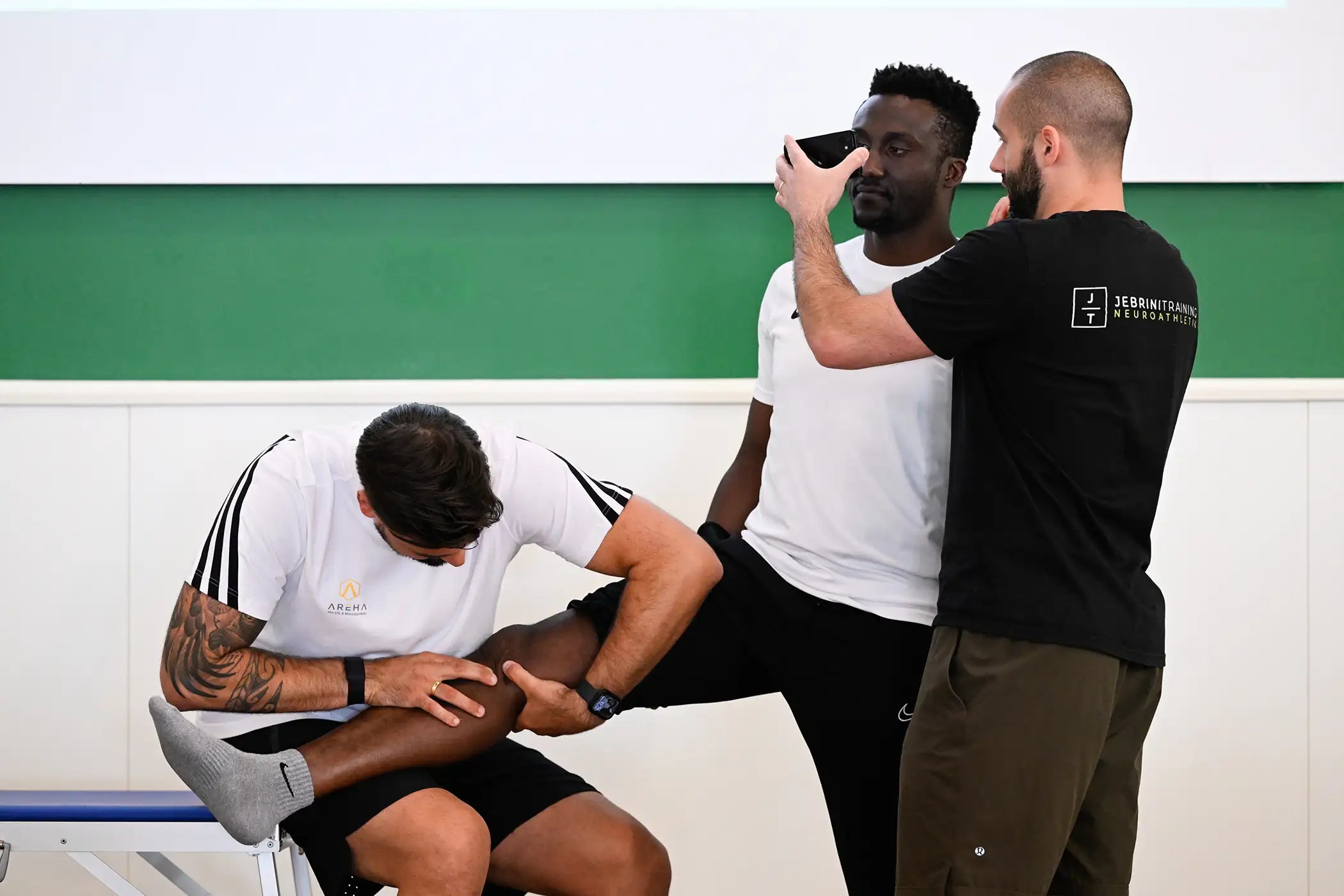
By slow squat movements to the pain point, combined with gaze focus on the Vision Stick (held low), central nervous system processing can be improved. The goal: less pain, more mobility (Fig. 3 a + b).

Fig. 3 a + b: Improvement of pain during hip flexion in a deep squat with the Vision Stick.
Sensory Activation of Peripheral Nerves
Sensory stimuli on injured structures can also help, e.g., through vibration with the ARK Z-Vibe on the affected side. This way, the brain can be specifically informed and protective patterns can be changed.
[[featured_products]]
Exemplary Integration into a Therapy Unit
As common loading principles of neurocentric training, approx. 30 minutes daily are recommended. These can easily be broken down into smaller time elements and integrated during the course of therapy. For example, an exemplary implementation for integration into a therapy session or a separate training session during the course of therapy could be as follows:
Activation of Movement-Controlling Systems Before or During Warm-up
Before starting the actual training session or therapy, it is worthwhile to specifically activate the systems that control our movement. This primarily includes joint mobilization to expand range of motion and prepare the central nervous system for the following stimuli.
Additionally, visual and vestibular training can be used – bilaterally or unilaterally, depending on the findings. Especially with known weaknesses in one of these systems, this can improve neuronal control and noticeably optimize movement control. Thus, the warm-up becomes more than just warming up: It becomes the targeted neurological activation of the body.
Between Sets or Series
Between sets, one or two targeted exercises can be incorporated to sensory activate the affected joint or address the visual system. Important here: The exercises should be simple, quick to implement, and doable without much cognitive effort. This keeps the focus on the actual training while the nervous system actively participates.
Cool Down
At the end of the session, the focus should be on joint and nerve mobilization of the previously stressed areas. This supports regeneration and ensures that the newly gained range of motion is maintained long-term. Additionally, the following exercises can be incorporated:
- Mobilization of the spine (cervical and thoracic spine)
- Mobilization of the feet
- Eye relaxation (e.g., through palming or gentle eye massage)
- Breathing techniques to relax the nervous system
The original article Neurocentric Therapy can be found at: sportaerztezeitung.com
Hands-on Neuro-Athletics: 4 Applications for Your Practice
In four exciting sessions, Yassin and Berengar show you how neuro-athletic training and physiotherapy can be meaningfully applied in practice. Various complaints and clinical pictures are examined and treated with the support of the best neuro-athletic tools. Even with partial paralysis, targeted exercises can be used for reactivation.
[[featured_products]]
Session 1: Neuro-Athletic Training for Back Pain
Do you often have pain when sitting or tying your shoes? Can you get out of the car or do you twist into a protective posture? Can you sleep through the night or do you have trouble lying still for long periods?
Back pain remains one of the most widespread common ailments. About two-thirds of all Germans suffer from it regularly. Hardly surprising: We sit too much and move too little. Our body is not designed for that. However, regular exercises for back pain can help.
>> Recommended reading: 6 Neuro-Athletic Exercises for Back Pain
Yassin and Berengar show you how everyday back pain can be treated:
Session 2: Neuro-Athletic Training for the Vagus Nerve
Do you have sleep problems? Do you suffer from chronic pain or digestive disorders? Do you get out of breath easily? The cause of these problems can often be found in the autonomic nervous system and the vagus nerve.
The vagus nerve is the tenth and longest nerve of the cranial nervous system and its name is not without reason; "vagus" means "wandering" in Latin. In fact, this nerve runs through large parts of our body and connects the brain with many organs, including the heart, lungs, and intestines.
A well-functioning vagus nerve helps us cope better with stress by ensuring that our body can transition more quickly from a state of tension to a state of relaxation.
Berengar and Yassin show you in the video how the vagus nerve influences your well-being and how you can actively stimulate it:
Session 3: Neuro-Athletic Training for Neck Pain
Do you often have neck pain? Does your neck pinch when you do a shoulder check while driving? Can you turn your head properly to the side?
The causes of neck pain can be diverse, and often a combination of different factors is at play. One of the main causes is muscular tension resulting from inadequate or unfavorable posture – whether from sitting in front of the computer for hours or from incorrect positioning during sleep. The increasing use of smartphones also often leads to what is known as "Text Neck" strain, where the neck remains in a downward-tilted position for extended periods.
Berengar and Yassin show you in the video what professional actions can be taken for neck pain:
Session 4: Neuro-Athletic Training for Shoulder Pain
Does your shoulder hurt when you reach for the top shelf? Do you sometimes have numbness in your arm that extends to your fingers? Are you afraid to lift or push heavy boxes because the shoulder pain will return?
Shoulder pain manifests as discomfort and inconvenience in the area between the neck and the upper arm. It can be acute or chronic, vary in intensity, and be exacerbated by various movements or postures. The shoulder itself is the most mobile joint in the body and is surrounded by a complex structure of muscles, tendons, and ligaments, making it particularly susceptible to injury or wear and tear.
Berengar and Yassin show you in the video how you can treat what is known as shoulder impingement with neuro-athletic exercises:
[[featured_products]]
Physio meets Neuro - Interview with Berengar Buschmann and Yassin Jebrini
In the interview, physiotherapist Berengar Buschmann and neuro-athletic trainer Yassin Jebrini discuss the opportunities of this collaboration.
ARTZT: Yassin, do you believe that traditional physiotherapy with its established methods and techniques may be outdated?
Yassin Jebrini: No, not at all. The techniques used demonstrably create added value for some patients. However, it certainly makes sense to broaden the perspective on pain and other rehabilitation measures, because their causes go beyond primarily musculoskeletal therapy.
ARTZT: Berengar, is neuro-athletics perhaps just a passing trend?
Berengar Buschmann: It is certainly a trend. During the peak of the fascia trend, I first experienced real trend waves. For me, however, it's not the trend that's decisive, but the substantive strength that also advances me professionally. Here, one may certainly be skeptical of any topic that attracts broad interest.
ARTZT: How would you measure the success of your treatment approach?
Yassin: Through reflexive assessments for the therapist and sensory and motor assessments for the client, we can immediately evaluate for each measure whether we are currently generating added value. Only in this way can we guarantee that all chosen measures are truly helpful for the patient.
Berengar: In my opinion, there are still too few objective tests in the world of neuro-athletics. Some things are primarily subjective. For example, in training sessions with Yassin, we used force measuring devices that objectively measure forces in Nm. However, success also comes through subjectivity, for example, if the pain after techniques is immediately less.
ARTZT: What type of injuries or illnesses do you treat most often?
Yassin: That varies greatly. Since I am not a physiotherapist, patients usually only come to me when their rehabilitation is complete and the desired success has not been achieved. We often see clients with pain problems or restricted movement that doctors and physiotherapists have not been able to resolve.
Berengar: In my case, it's all sorts of sports injuries and overuse syndromes. Everything from the world of orthopedics and surgery.
ARTZT: How do physiotherapy and neuro-athletics differ in terms of the rehabilitation process?
Berengar: I believe they don't differ but complement each other. Fascia rollers or tapes, for example, are used just as often in physiotherapy as in neuro-athletics. It depends on the perspective: Am I addressing the nervous or connective tissue system more with it? I believe both are addressed. However, depending on the goal, different application focuses can be set in detail.
Yassin: In neuro-athletics, in addition to musculoskeletal work, we also focus on restoring movement control and regulation through the central nervous system. If, after an injury or surgery, a structure is not stressed as usual for a certain period, this affects not only the load-bearing capacity of the bones, muscles, tendons, fascia, and ligaments, but also the neural areas that innervate and control these structures. We must always keep both in mind within the framework of rehabilitation measures.
ARTZT: How do you see the future for physiotherapy and neuro-athletics with regard to new insights and developments in rehabilitation?
Berengar: That's hard to answer. The future of physiotherapy is a complex question in itself. With regard to the match between these two worlds, I believe that much will grow together and converge more and more. Neuro-athletics will certainly become a firmly integrated form of application in its basic principles.
Yassin: Our colleague Felix Danners, a physiotherapist, recently said that the term neuro-athletics doesn't really do justice to the matter itself, as it's about more than integrating functional neurology into athletic training or therapy.
When people hear the word neuro-athletics, many expect a new set of techniques and tools. However, the neurocentric perspective brings not only a wide range of tools but, above all, a new point of view. We tend to apply a familiar range of techniques to a particular problem, which sometimes leads to success, but sometimes not. The neurocentric approach brings a clear structure here, indicating when and what can be meaningfully used for which problem. At this point, I like to recommend the podcast "Zwischen Augenklappe und manueller Therapie," Episode 10 - Felix was at a training course.
ARTZT: Yassin, is neuro-athletics capable of covering the broad scope of traditional physiotherapy?
Yassin: The question implies the substitution of physiotherapy with neuro-athletics training, which is absolutely not conducive. I like to use the metaphor of functional neurology as an umbrella under which all techniques from therapy and training fit, and which explains to us when and in what context which technique can be profitably used in what dosage.
As Berengar has already stated – we all work on the same system; we only have different approaches through different techniques and tools. Some are more targeted and in line with the needs of the patients' nervous system, while others are more random and habit-based. The neurocentric training approach perfectly complements physiotherapy and enables faster and more targeted therapy successes. The musculoskeletal perspective is complemented by that of neuronal movement control and regulation.
ARTZT: Berengar, is there a tendency in physiotherapy towards treating symptoms instead of a holistic root cause analysis?
Berengar: Yes, definitely. But the current, serious reason for this is not necessarily unqualified therapists, but the working conditions with extremely limited time intervals per patient.
ARTZT: Are there certain injuries for which you would recommend collaboration with the other treatment method?
Berengar: Based on previous experience, successful joint steps can be taken for herniated discs, ACL tears, and, for example, shoulder impingements.
Yassin: Definitely. Especially regarding manual therapeutic measures, physiotherapists are generally much better trained and more experienced than trainers and are also on safer legal ground here.
ARTZT: What would need to be done so that patients benefit from an integrative approach that combines the best elements of both treatment methods?
Berengar: To hope for visionary, highly motivated, and willing-to-learn therapists and to increase the chance, a reform in the German healthcare system is needed. Ultimately, it doesn't mean that the physiotherapist has to replace the neuro-athletics trainer; instead, they can test to what extent the approaches from this are relevant for the patient and then refer them to professional colleagues. For this, as a physio, I also need to understand this systemic thinking.
Yassin: For me, functional neurology should be integrated into the training of therapists to enable more complete treatment. This applies equally to sports scientists and trainers. There is a gap that needs to be closed in the field of training and therapy. Everyone would benefit from this. The fact is: We always work with the nervous system. Therefore, we should do it responsibly and not randomly, based solely on our own habits and conveniences.
Conclusion: Neuro-athletics in physio practice: An approach that thinks ahead
Neuro-athletics is more than a new therapeutic approach – it is an invitation to question customary perspectives and to expand musculoskeletal therapy through targeted stimuli to the nervous system. Regardless of the type of pain: The combination of visual, vestibular, and proprioceptive impulses with classical physiotherapy creates new possibilities – directly at the spinal cord, via the medulla oblongata, reticular formation, and Co.
Berengar Buschmann and Yassin Jebrini demonstrate with "Physio meets Neuro" how coordination, pain processing, and movement control can be specifically improved – through an understanding of what starts in the head and becomes tangible in the body.
Our authors and experts
Behind Physio meets Neuro are experienced therapists, trainers, and coaches who have not only theoretically understood neuro-athletics but also apply it practically every day. Here are the minds who contributed their experiences, ideas, and approaches to this article.
Responsible for the article Neurocentric Therapy:
Björn Reindl
Owner and managing director of the interdisciplinary health center R2comSport in Neu-Isenburg, Chiropractor (M.o.C. Swe.), Osteopath and lecturer in the field of DOSB sports physical therapy
The naturopath and physiotherapist bac. Nl. served as head physiotherapist for Eintracht Frankfurt Fußball AG for seven years. Prior to that, he treated FSV Frankfurt and Kickers Offenbach in their respective clubs.
Kevin Nickoll
Sports scientist (M.A. Sports Science) at R2comSport in Neu-Isenburg
His focus areas include medical build-up and athletic training, Functional Range Conditioning, and neurocentric training. He is primarily responsible for supervising all performance athletes from various sports at (inter)national level and specializes particularly in the lower extremity.
Responsible for the concept Physio meets Neuro:
Berengar Buschmann
DOSB Sports Physiotherapist, Physiotherapist B.Sc., Sect. Naturopath & Trainer, Owner AREHA Idstein
Berengar Buschmann is a sports physiotherapist with passion and lives this calling dynamically and optimistically in his "second professional life." He has been a lecturer for 10 years and has worked with athletes from high-performance/professional sports (Top 100 ATP tennis players as well as Bundesliga and Champions League footballers) for 6 years. In his first professional life, he was a professional footballer, was declared a sports invalid, and came back to life stronger than ever before. These experiences help him today to help his clients and patients. Since then, Buschmann has been tinkering and developing the "most perfect concept" for maintaining health with his AREHA team as a "health visionary."
Yassin Jebrini
Sports Scientist, Neuro-Athletic Trainer & Instructor
Yassin Jebrini is one of the leading coaches and instructors in the field of neuro-athletics. He uses his experience as a Z-Health Master Practitioner, former competitive athlete (football & rowing), Master's graduate of the German Sport University Cologne, and long-standing coach to train ambitious trainers and therapists as well as athletes in neurocentric training and therapy approaches. His six-month Neuro-Athletic Mentorship is one of the most professional and in-depth training programs in the German-speaking world.
This article was originally published on May 17, 2025, on artztneuro.com.

Written by Jonas Schön