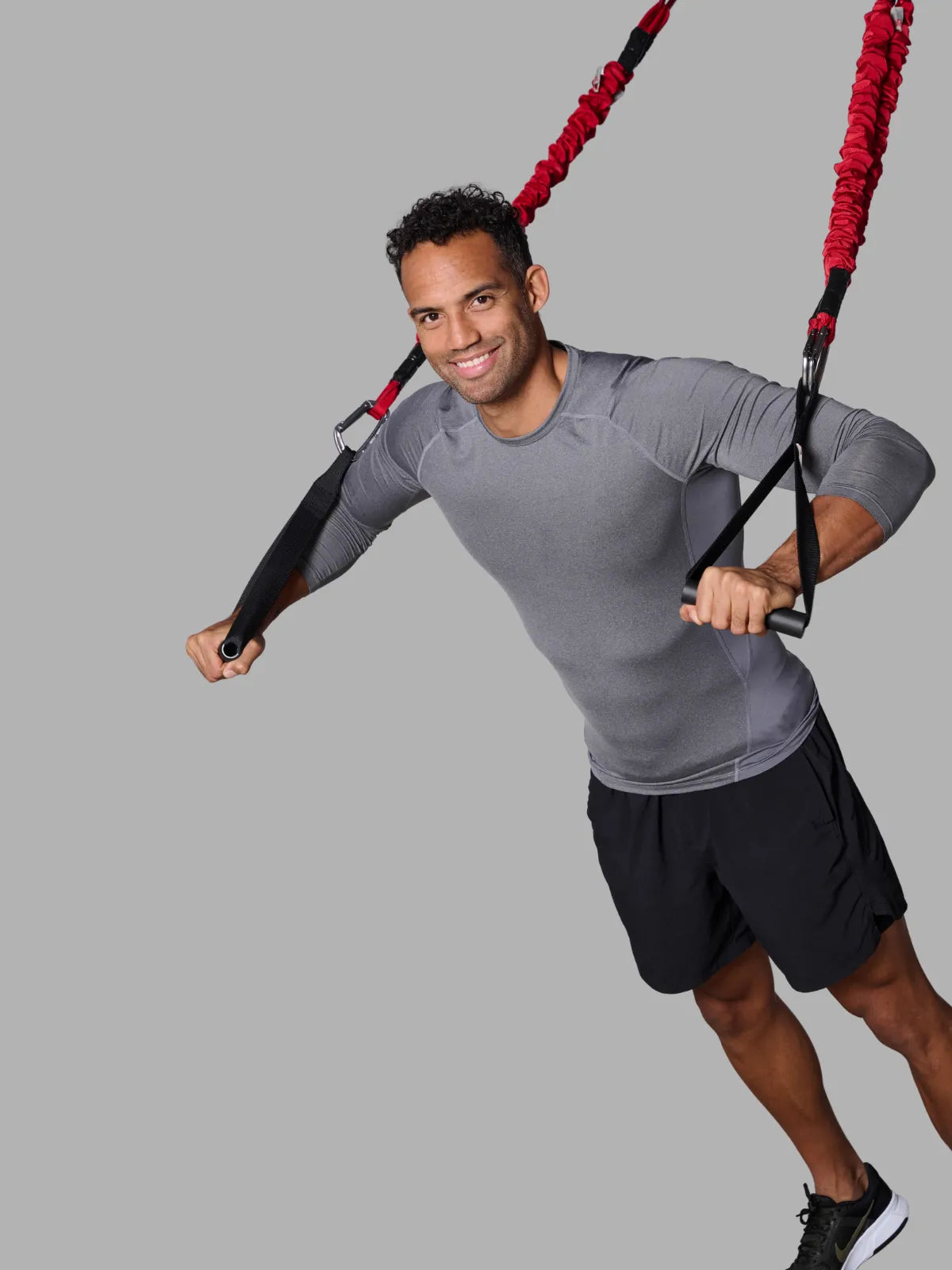

6 Neuroathletic Exercises for Back Pain
Reading time: 5 minutes
Do you often suffer from back pain, tension, or lumbago? Neuroathletics coach Kevin Grafen from Fitnessland Kensho shows you 6 back exercises that can help alleviate acute pain during your back training. This way, you can avoid pain and medication and keep your spine healthy in the long term.
Contents
Lack of exercise and prolonged sitting are the most common causes
The causes of everyday back pain are diverse. They often manifest through various symptoms such as pulling, stabbing, or tension. Today, the most common cause is lack of movement due to frequent sitting. If you work at a desk, you spend around eight hours a day sitting – not including your free time. This is often accompanied by a hunched posture and permanently bent legs as potential triggers.
This puts a strain on the permanently pressured intervertebral discs and shortened ligaments. Because: Sitting with bent legs permanently strains the knee joint and the entire back musculature.
The bad news: The human body is simply not designed for prolonged sitting.
The good news: You can do something about back problems yourself with simple means. And you can do it every day – we'll show you how.
[[featured_products]]
Just a few minutes of exercise can help
For everyday back pain, movement, in addition to warmth, is particularly helpful. If you sit all day, you should get up briefly every 30 minutes, stretch, and ideally move a little. A short, regular break is always recommended to clear your head and gather new mental strength. One to three minutes can already be enough.
Perhaps you also have the opportunity to walk a few steps. Why not take a short walk during your lunch break! Many offices have height-adjustable desks. They allow for varying standing and sitting without having to interrupt work, which relieves the back.
Strong back, healthy body – how targeted training prevents pain
Tense and underworked back muscles want (and need!) to be regularly trained in everyday life. The muscles in the neck and glutes are also often affected. The right back exercises help with this and can also protect you from injuries such as slipped discs and lumbago. Such exercises also help to reduce the risk of other spinal diseases. Trained back muscles also prevent muscle tension and promote a healthy and straight posture.
For a short break in between, we have 3 simple neuroathletic exercises for you that can help with regular everyday back problems.
3 Neuroathletic Exercises for Back Pain
Do you also suffer from back pain, perhaps limited mobility in the back of your leg, and maybe you've sat too much in your home office, causing neck pain? The following three neuroathletic exercises can help you.
First, you get an overview of the starting position by testing two or three times how far down you can go in the forward bend. Well, can you touch the floor with your fingertips? You can then directly check whether the current state has improved after the first exercise.
Exercise 1: Shoulder raises
In the first exercise, a Super Band helps you to raise and lower your shoulders against resistance while standing with your feet shoulder-width apart. This not only trains the muscles in the shoulder and neck but also activates the 11th cranial nerve, which is responsible for relaxing the extensor muscles, i.e., the back of the legs.
How it works: Stand with your feet together on the Super Band and grip it as low as you can. Stand upright. Then pull the band upwards with your shoulders. Keep your legs together.
Do 5 - 10 repetitions.
Exercise 2: Eye push-ups
For the second exercise, you need a Vision Stick.
How it works: Hold the Vision Stick at arm's length in front of you, look at the top letter, then slowly pull the stick towards you between your eyes - as far as you can still clearly recognize the letter. Squinting is intended here!
Then return to the starting position. After several repetitions, you will have activated both the extensor and flexor muscles by alternating near and far vision. This is controlled in certain areas of the midbrain.
Do 5 - 10 repetitions.
Exercise 3: Tongue circles
This exercise has a calming effect on the neck muscles and can help relieve headaches. The best part: It works without any tools.
How it works: Simply make circles with the tip of your tongue clockwise and counter-clockwise.
Circle 5 times counter-clockwise and 5 times clockwise.
Finally, you can go into the stretching position again. You will be amazed at what has happened.
Bonus exercise: Elevated leg position
For this exercise, get an elevation such as a chair, a box, or a large cushion. The following position helps you to relieve the lumbar spine and back muscles.
How it works: Lie flat on your back and place your legs so that your hips and knees form a 90-degree angle – like a "staircase." Your lower legs rest relaxed on the elevation.
Stay in this position for 10 to 20 minutes and breathe calmly and deeply to fully relax your back muscles. If necessary, you can repeat this exercise several times a day.
[[featured_products]]
Lumbago: Tips when pain strikes
The dreaded lumbago is a sudden, sharp pain in the lumbar or thoracic spine. In medicine, it is referred to as Lumbago. Generally, the pain subsides on its own within two to five days. If the lumbago symptoms persist longer, a doctor should be consulted. In stubborn cases, targeted therapy can also help, such as physiotherapy or specific back exercises to strengthen the muscles and prevent recurring pain. Heat treatments and gentle mobilization of the spine can also be supportive.
3 Neuroathletic Exercises for Lumbago
Even with lumbago, movement is better for the muscles than resting in bed. The hunched protective posture that affected individuals often adopt during lumbago can lead to painful tension. This can further prolong the acute pain. You can find out which neuroathletic exercises you can try for lumbago symptoms in the video:
Exercise 1: Eye exercises
When it comes to the muscles in the back, our eyes play an important role. Both the flexor and extensor muscles are imperceptibly influenced by the position of the eye: If we turn them inward, i.e., squint, the flexor muscles are activated. If we look into the distance, we activate the extensor muscles.
How it works: The back and forth movement of your eyes from outside to inside and back results in a constant, fluid change between the outer and inner position of the eyes – from far to near. In this way, the flexor and extensor muscles in the back are alternately stimulated, which often leads to noticeable relaxation.
This is where the Brock String with its three colored beads comes in handy.
The first exercise involves "eye jumps," which result in a steady, fluid change between the outer and inner position of the eyes – from far to near. This alternately stimulates the flexor and extensor muscles in the back, often leading to noticeable relaxation.
Do 5 - 10 repetitions.
Exercise 2: Diaphragmatic breathing
Acute back pain often leads to restricted breathing. Conversely, this means that conscious, deep breathing can have a positive effect on your back pain.
How it works: Place the breathing belt tightly around your lower chest. Additionally, place your hands on your lower ribs. Now inhale deeply and slowly. Your chest should rise upwards and outwards. Then exhale slowly and for a long time. Afterwards, try to breathe so that your abdomen expands in all directions when you inhale – as if you had swallowed a balloon that is slowly being inflated. This movement can help to free your back and thus relieve and prevent back pain.
Do 5 - 10 repetitions.
Exercise 3: Tongue stimulation
With the right stimulation in the oral and pharyngeal area, you can soothe and relax the extensor muscles.
How it works: Place the Z-Vibe with the tongue depressor on your tongue and switch on the device. Slowly push the device towards your throat. Please make sure that you do not insert the vibrating pen so far that you gag.
Massage your tongue and throat muscles for approx. 20 seconds.
[[featured_products]]
Conclusion: Your back doesn't have to hurt
With a few simple tips and exercises, you can do something every day to combat your back and lower back pain. For long-term health and a strong back, regular exercise is key – this way you stay fit and can often avoid doctor's visits.
Therefore: Go for walks, stretch in between, and do back exercises regularly. Just a few minutes a day can permanently strengthen your back and keep your body in shape. This way, you can avoid chronic pain, doctor's visits, painkillers, and expensive treatments due to back pain.

Written by Jonas Schön